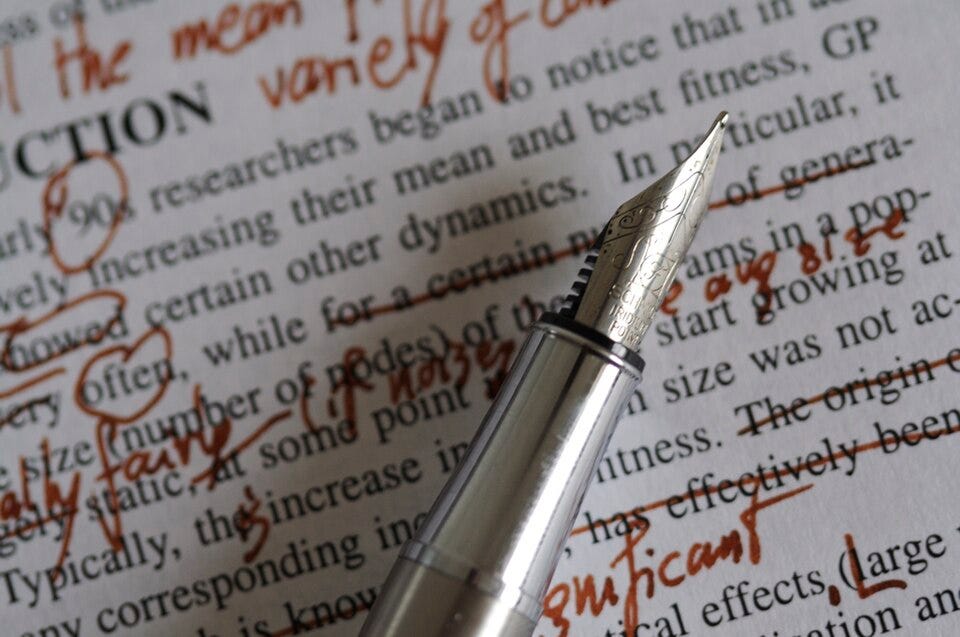
My favorite passages in my own writing are the children of infinite revisions. It’s rare for the first draft of a sentence to be a source of pride. Instead, I anguish over the words, constantly backtracking across the pages I’ve theoretically finished. I return, revise, reconsider, revisit, and repeat, always hoping for something better.
When I write a post on this website, I don’t have the time for editing. I do my best to share something meaningful, and I move on to the next ask on my “To Do” list. However, there are instances where I can’t leave things well enough alone and pride makes me return to a post. Last week I published a post entitled “Intention vs. Accusation.” I’m sharing below edits I subsequently made since some of my readers consume my articles for their insights on writing and, for me, most of writing is revision.
Change #1
I made the first sentence a stand-alone paragraph. “One of the greatest perils of writing is to be misunderstood (the other, of course, is to be understood too well)” is sufficiently thought-provoking to keep a reader on the page but the following sentence, “Misunderstandings in reading sometimes arise because a reader treats a particular literary character like an actual person,” diminished some of the first sentence’s force given its immediate proximity.
Change #2
The words “of the story” were removed from the sentence, “More accurately, readers relate to characters like specific people known from outside the text of the story, souls whom they dislike and by whom they feel slighted,” because the phrase was redundant and added nothing of value.
Change #3
The sentence “There are millions of book choices in the world, so a reader donating time to your novel, the book awash in that sea of options, is deeply appreciated. It’s hard to be angry with someone who showed you a kindness” was changed to “There are millions of books in the world, so any reader donating time to your novel—the book itself awash in that sea of options—is deeply appreciated.” The phrase “book choices” was tightened to “books,” and the later use of book in the sentence was given an intensive pronoun (“…the book itself”). I also replaced two commas with em dashes, though whenever I use an em dash I fear an accusation of AI writing since Large Language Models use this punctuation more frequently than humans.
“A reader” was changed to “any reader” because “any” strengthens the notion of gratitude on the part of the author.
I’m still not satisfied with the use of the second person (“…to your novel”) within this sentence. It occurs over a dozen words in and has no antecedent in the opening phrase. Perhaps I’ll improve it in the future.
Change #4
“Most writers (I suspect) have little appetite for composing a Rorschach test instead of a story that is heartrending or transformative or beautiful” was revised to “Most writers (I suspect) have no aspirations for composing a Rorschach test instead of a story that is heartrending or transformative or beautiful.” The word “appetite” implied more of tolerance than purpose while “aspiration” hit the nail on the head.
Change #5
The observation “Perhaps, but this gives little credit to my imagination” was made more explanatory through the wording, “Possibly, but this suspicion gives little credit to my imagination, which is perhaps a worse slight.” Additionally, the sentence has become comical in suggesting that underestimating my imagination is more insulting than believing my fiction’s immorality mirrors my own.
Change #6
“To write is to invite misunderstanding” was improved to “To write is to be always misunderstood to some degree or another.” The latter sentence makes misunderstanding inevitable rather than potential. The sentence is also more vulnerable and, perhaps in being so, attracts more compassion and emotional investment from the reader.
I don’t think the concept here is particularly original. I’m sure it has been stated many times before but often truth is more effective than originality.
Change #7
Finally, I shortened the sentence “It is the blood of the sacrifice of writing.” The revised version reads, “It is the blood of writing’s sacrifice.” There’s no fat left on this sentence. Using fewer words both places the word “blood” in closer proximity to the description of writing as sacrifice (sacrifice in this context alluding to a blood-shedding that offers a life in exchange for approval) and ends the sentence with the word “sacrifice,” emphasizing it.